Global accessibility requirements
Learn how to ensure people of diverse abilities can use and interact with our digital products and tools.
The Visa Global Accessibility Requirements (VGAR) are a set of functional expectations that distill Web Content Accessibility Guidelines (WCAG) into easy-to-learn resources for product teams, customers, and partners. These requirements help ensure Visa’s digital products meet accessibility standards and should be used to guide product planning, design, and development.
To scale accessibility at Visa, we’ve established a unified internal standard for building accessible products. The Visa Global Accessibility Requirements (VGAR) helps teams focus on building rather than interpreting accessibility standards.
- Communicates how we implement WCAG 2.2 AA standards in practice to our employees, clients, and partners.
- Provide an easy-to-follow testing methodology for web and mobile products.
- Centrally manage and stay up-to-date with current accessibility trends.
Requirements and test procedures
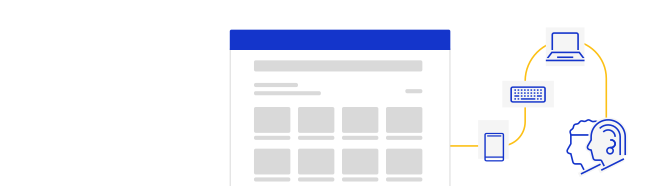
Visa Global Accessibility Requirements outline the expected behavior for accessible user experiences across web, mobile, PDF, and email experiences. Visa teams follow these requirements during design and development.
Each requirement includes specific test procedures to validate compliance at every stage. Visa teams run both automated and manual tests to ensure all applicable requirements are met.
WCAG 2.2 AA
At Visa, we aim to build all web and mobile components to conform to level AA of the Web Content Accessibility Guidelines 2.2 (WCAG 2.2), the internationally recognized benchmark for building accessible websites developed by the World Wide Web Consortium (W3C) for enhancing web accessibility. W3C is an international body that develops open standards for the web, and WCAG 2.2 focuses on making web content accessible to all, regardless of abilities. Visit WCAG 2.2 to learn more about current web content accessibility guidelines.
Connect with us
Have questions or ideas? Visit our office hours, join Visa Accessibility on Teams, or get general VPDS help by visiting Support.